AES-256-GCM
Every value in the vault is encrypted with AES-256 in GCM mode — authenticated: if someone alters it, it won't open.
the vault · at rest
MONO uses your keys without seeing them. Nothing goes out without your OK.
Every account gets its own server. Every action passes through one checkpoint with permissions. Charging, sending and publishing wait for a person. And everything that happens is written in a log nobody can quietly rewrite.
Found something? security@mono.vip
MONO is a desktop app for Windows, Mac and Linux that puts a team's conversations, people, files and data, board and browser in one window, with an AI agent working inside. Every account gets its own server — its box — where the files, databases, vault and agent live. MONO picks the best AI model for each task (Claude, GPT, Gemini and others), and it never sends, charges or publishes without a person's approval.
For teams — agencies, sales, operations and professional firms — that want to work in the same files with AI inside, instead of each person alone in a chat. It also works for one person.
When you sign up, MONO creates a server just for you and your team. Your files, sheets, databases, conversations and keys live there — not in a database shared with other customers.
To answer, MONO sends the request to the best model for the task — Claude, GPT, Gemini, Kimi, DeepSeek. Your keys and passwords never travel with it. We don't train models with your content.
MONO's control plane keeps what it needs to run: your account, your billing and your box's health. Since 11 Oct its master key no longer travels to any box.
When MONO needs a password or an API key, it doesn't ask you to paste it into the conversation. It gives you a one-time link.
The value goes straight into your box's vault, encrypted with AES-256-GCM. The link works once and expires. MONO never gets the text — and neither does the app.
When MONO calls Stripe, your database or any API, it asks for the key by name. The broker in your box puts it into the request — outside the model — and gives MONO only the answer.
To read a sealed value, you open another one-time link, as yourself. «Forget» removes it from the vault.
Every tool MONO has — and every button in the app — passes through the same checkpoint before it runs. It checks who's asking, their level, and whether the action needs a person. A tool without a declared permission can't even be registered.
| Action | Ownerthe account | Partneradmin · decides with you | Can workyour team | Can lookread only | Guestonly the app you share |
|---|---|---|---|---|---|
| Ask your data, see what happened | Can | Can | Can | Can | its app |
| Edit the board, sheets and documents | Can | Can | Can | Can't | Can't |
| Run what exists, write to your databases | Can | Can | Can | Can't | Can't |
| Send, charge or publish outside the box | Can — when MONO does it, it waits for a person's OK | Can — when MONO does it, it waits for a person's OK | Can't | Can't | Can't |
| Invite people and change levels | Can | Can | Can't | Can't | Can't |
Since 9 Oct, approving needs the app's own credential, issued per person: a coding agent holding the box's token can't approve its own request.
You asked MONO to email the quote once the totals were right. It writes the email and gets it ready — that's as far as it goes alone.
Charging, publishing and sending outside your box need a person. The checkpoint stops them and nothing goes out — even if a model was tricked into trying.
In «Waiting for you» you see what, why in MONO's words, who asked, from which conversation or worker, and when. Approve once, always for that worker, or say no.
Approved, the email goes out. The decision, who took it and what happened stay in the log.
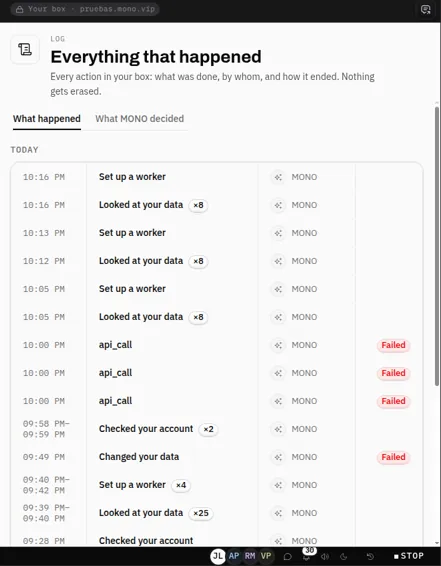
Every action in your box — by a person or by MONO — goes into a chained log: each entry carries the fingerprint of the one before. Changing or removing one breaks the chain, and it shows.
The names you can check, and what each one protects.
Every value in the vault is encrypted with AES-256 in GCM mode — authenticated: if someone alters it, it won't open.
The vault key is derived from your box's secret with 600,000 rounds: slow on purpose for anyone trying to guess it.
Sealed conversations get their own key per entry, derived with HKDF: one key opens one thing.
The app reaches your box through an encrypted tunnel. Everything between them travels over TLS.
If the checkpoint can't confirm a permission, the answer is no. A failure never turns into a yes.
Post-quantum key exchange (NIST FIPS 203) is already in MONO's code. Wiring it into the link between your box and our control plane comes next.
When MONO reads a page, an email or a file, what it reads is treated as text from a stranger — never as instructions. And if a model still gets fooled, the checkpoint doesn't: sending, charging and publishing wait for you, and keys never reach the model.
We attack our own product. These are the holes the review found — and how each one closed.
It could read file:///opt/mono/.env and the server's metadata address. Now it opens only http and https, never link-local addresses, and stops if a redirect leaves.
New boxes were born with a key they didn't need. It isn't written to any box anymore, and the metadata is readable only by the system.
A coding agent with the box's token could approve its own request. Now deciding needs a credential only the app gets — per person, revocable.
Stripe can deliver the same event more than once. Credits are now checked against that payment before they're added.
A signed-in user could edit fields of their own account that only billing should touch. The fix (migration 056) is live: those fields are now written only by billing.
A failed payment doesn't turn off your work, and turning off doesn't delete it. If you cancel, your box goes straight to «off» — with the same days to come back.
Your box keeps working, and we tell you by email and in the app.
The server stops. We tell you how to take your data out and how to come back.
We make a complete copy of the disk. Only when it's ready is the server deleted.
In grace, it just continues. Off, it turns back on, as you left it.
The same list as our privacy notice — what each one is for and what it receives.
| Service | What for | What it receives |
|---|---|---|
| AI models | Answer what you ask. MONO AI, our model router, picks the model for each task. | The content of the request. Never the vault's keys. |
| Stripe | Charges, subscriptions and coupons. | Your plan and payments. Your card goes to Stripe; MONO never sees it. |
| Supabase | The control plane's database. | Your account and subscription. |
| Deployalo | The servers where your box lives, its backups, mono.vip and the encrypted tunnel to your box. | Your box (United States, Virginia). |
| Analytics | Only if you accept cookies: Google, Meta and PostHog. | Visit and campaign data. |
Write with what you saw and how to reproduce it. We answer, we fix it, and we tell you when it's closed. Please test only against your own box.
security@mono.vip